

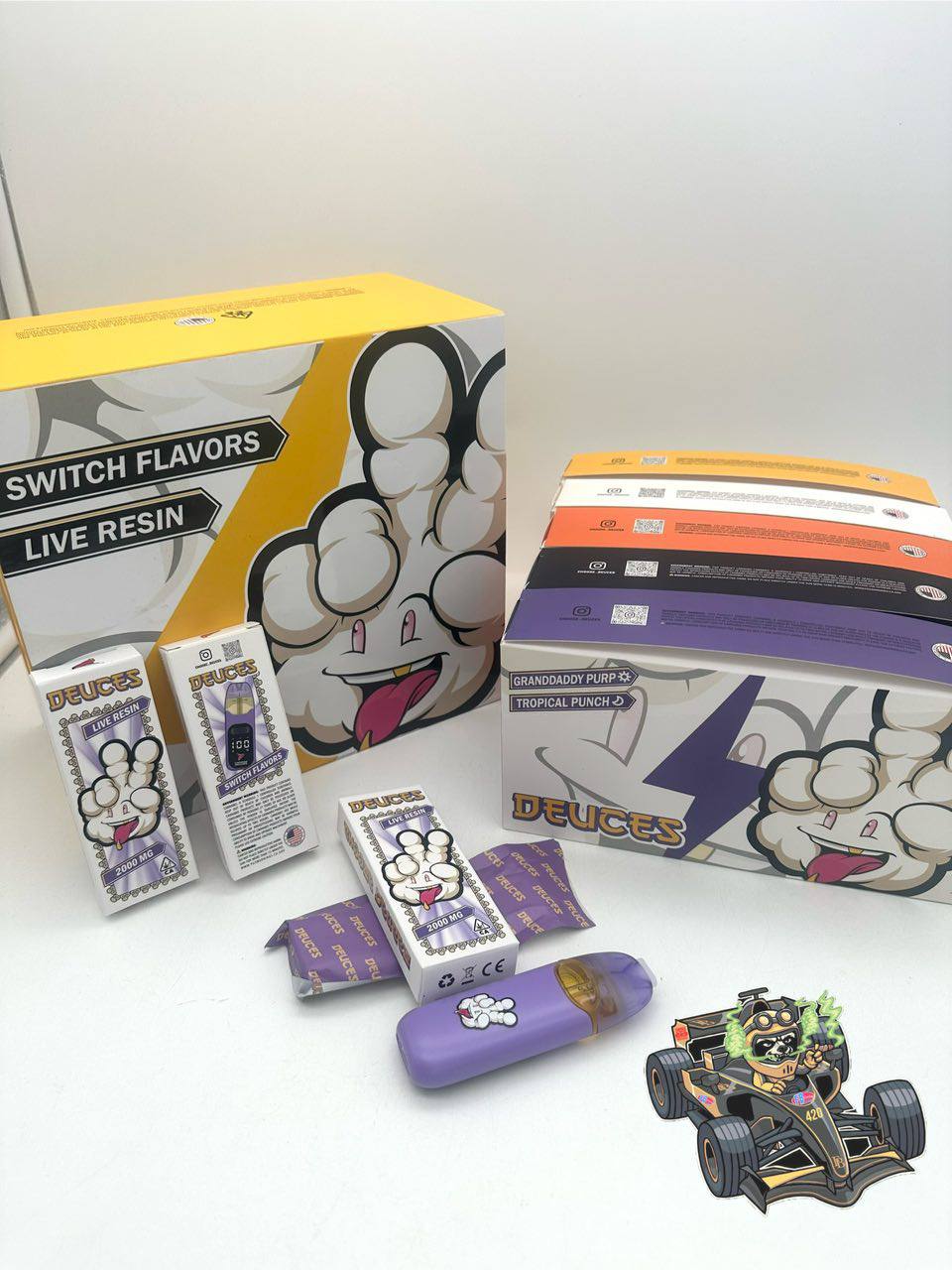
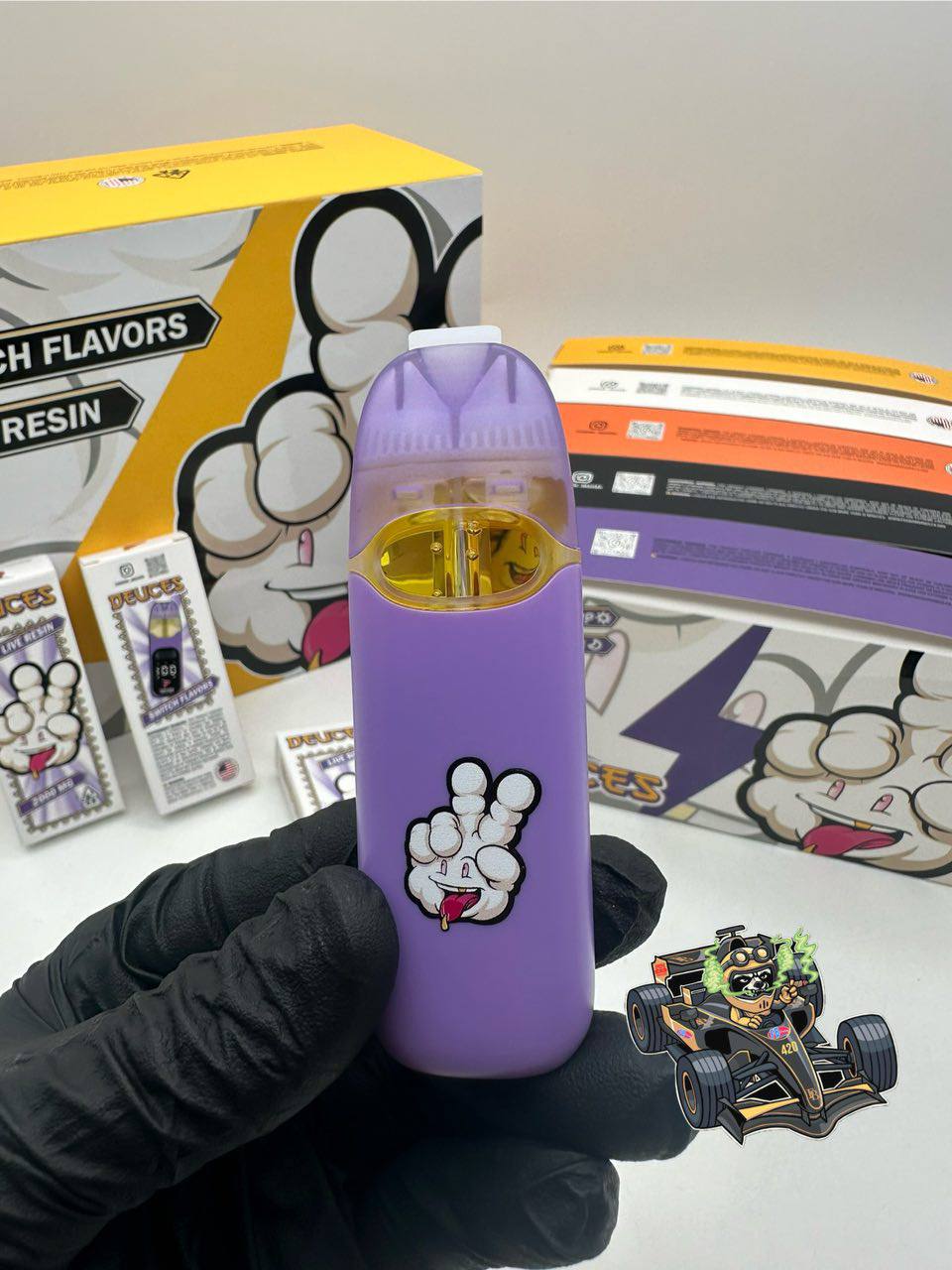
Deuces Dual 2G Disposable: Product Overview
Introduction
The Deuces Dual 2G Disposable is a compact disposable vape format designed around a dual-chamber configuration. Rather than relying on a single reservoir, the device incorporates two separate 2G chambers within one unit. This configuration gives the product a distinct format compared with standard single-chamber disposable devices.
The overall design combines two reservoirs with a portable hardware format. As a result, the device presents its contents through a single handheld unit rather than through two separate devices. The exact contents, cannabinoid profile, flavor selection, hardware specifications, and labeling can vary according to the particular product version and market.
Product information should therefore be checked against the packaging supplied with the individual unit. In addition, details such as cannabinoid concentration, ingredient information, batch information, manufacturing information, and testing documentation may differ between versions.
Dual-Chamber Configuration
The defining characteristic of this disposable is its dual-chamber design. Two separate reservoirs are incorporated into the same device, creating a format that differs from a conventional single-reservoir disposable.
Each chamber can contain its own formulation or flavor profile, depending on the specific version. Consequently, the experience associated with one chamber may differ from the other. The packaging should identify the contents of the individual chambers where applicable.
This configuration also affects the physical layout of the device. Instead of carrying two independent disposables, the dual design combines both reservoirs into one body. Therefore, the product can be identified primarily by its two-part internal configuration.
The exact operation of the chambers depends on the hardware used in the particular release. Some dual-chamber devices use separate activation mechanisms, while others incorporate a switching system or another method of selecting between reservoirs. The correct operating method should always be determined from the manufacturer’s labeling rather than assumed from the product name.
2G Per Chamber Format
The “2G” designation refers to the stated amount associated with a chamber or product configuration, although the precise interpretation should be verified on the packaging. Product labeling remains the most reliable source for determining the actual net contents.
Cannabis products can differ considerably in potency and formulation. For that reason, the amount of material contained in a device does not by itself indicate cannabinoid strength. A larger stated quantity does not automatically mean a particular level of potency.
Likewise, two products with similar stated quantities can have substantially different cannabinoid concentrations. Therefore, the cannabinoid percentage or milligram information printed on the package provides more useful information about composition.
Where laboratory testing is available, the certificate or test information can provide additional details about cannabinoids and other measured components. Such documentation can also help distinguish between different production batches.
Hardware Design
The disposable format combines the reservoir system, heating components, power source, and mouthpiece into one compact unit. Because these components are integrated, the device generally does not require a separate battery or cartridge system.
The exterior may feature branding, graphics, product information, and chamber identification. Meanwhile, internal components remain enclosed within the body of the device.
Hardware specifications can vary between manufacturers and production runs. Features such as battery capacity, charging capability, heating technology, airflow design, activation method, and indicator lights should therefore be confirmed through the product packaging or manufacturer documentation.
A disposable device may be activated automatically when airflow is detected, although not every model uses the same mechanism. Similarly, some hardware can be rechargeable while other disposable formats are designed for a single-use lifecycle. The exact configuration should not be inferred solely from the product name.
Form Factor and Portability
The compact form of a disposable device makes its physical dimensions an important part of its design. The integrated reservoir and battery system allows the product to remain within one handheld unit.
Its shape may also make the device visually different from traditional cartridge-and-battery combinations. Instead of requiring a separate power source, the necessary hardware is contained within the disposable body.
The weight, dimensions, mouthpiece construction, and exterior finish can vary according to the specific production version. Furthermore, packaging may differ between batches or markets.
Because product specifications can change, the information printed on the current packaging should take precedence over general descriptions found elsewhere.
Formulation Information
The formulation inside a disposable can contain cannabinoids alongside other ingredients used to create the intended product profile. Exact ingredients depend on the manufacturer and individual product.
Cannabinoid information is particularly important because products within the same general category can have substantially different compositions. THC concentration, CBD content, minor cannabinoids, and other measured compounds may vary.
Terpenes or flavoring components may also be present depending on the formulation. Their presence and source should be verified through the ingredient panel or available laboratory documentation.
For consumers who need to avoid particular ingredients, the package label provides the appropriate reference point. Product descriptions should not substitute for the official ingredient list.
Flavor and Profile Variations
Dual-chamber products may contain two different profiles, allowing the chambers to be distinguished from one another. The names assigned to these profiles can vary according to the specific edition.
Flavor descriptions are generally based on the manufacturer’s terminology. Words associated with fruit, candy, citrus, herbs, or other flavor categories describe the intended profile rather than guaranteeing an identical sensory response for every person.
Individual perception can also vary. Factors such as formulation, temperature, device characteristics, and personal sensitivity may influence how a particular profile is perceived.
Consequently, flavor names should be treated as product descriptors rather than objective measurements.
Packaging and Labeling
Packaging serves an important role in identifying the individual product. Information commonly displayed on regulated cannabis packaging can include the product name, net contents, cannabinoid information, ingredients, batch or lot details, manufacturing information, warnings, and testing information.
Regulatory requirements differ between jurisdictions. Therefore, packaging in one market may contain information that is absent from another.
Authenticity information may also be provided through batch numbers, QR codes, verification systems, or laboratory-testing references. When available, these details can be used to compare the physical product with information supplied by the manufacturer or authorized testing source.
A product description should not replace the information printed on the actual package. Instead, the package should remain the primary reference for the specific unit.
Laboratory Testing
Laboratory testing can provide information about the chemical composition of a cannabis product. Depending on the jurisdiction and testing requirements, reports may include cannabinoid measurements and screening for various contaminants.
Testing information is particularly useful when comparing products because the stated product category alone does not establish the complete chemical profile.
Results may be associated with a specific batch rather than every unit produced under a brand name. Therefore, batch information should correspond with the product being examined.
Testing documentation can also change when a new production batch is released. For that reason, an older laboratory report should not automatically be treated as representative of a newer batch.
Device Lifecycle
Disposable hardware is designed around a limited-use lifecycle. The usable period depends on factors such as battery capacity, reservoir quantity, heating system, and individual usage patterns.
A device may reach the end of its usable life when its contents have been depleted or when the power system can no longer operate the heating element. These two conditions do not necessarily occur at exactly the same time.
Some hardware includes charging functionality, while other models do not. This distinction should be confirmed through the packaging before attempting to connect a charging cable or accessory.
Because internal electronics and batteries are enclosed, the device should not be opened, modified, or dismantled.
Storage Considerations
Storage conditions can affect many types of cannabis products and electronic devices. Excessive heat, direct sunlight, moisture, and extreme environmental conditions can influence product quality or hardware performance.
A cool, dry environment away from direct sunlight is generally more appropriate for packaged cannabis products than prolonged exposure to high temperatures.
The device should also remain in its original packaging when practical, particularly when labeling and product identification need to be preserved.
Storage instructions supplied by the manufacturer or required by local regulations should take priority over general guidance.
Product Identification
Several details can help distinguish one version of a dual disposable from another. These details may include the printed product name, chamber names, net contents, batch number, packaging design, cannabinoid information, and testing references.
This information becomes especially relevant when multiple editions share similar branding.
Packaging can also change over time. Therefore, an older image of a product may not perfectly match a newer production version.
For accurate identification, the physical packaging and manufacturer information should be considered together rather than relying on appearance alone.
Regulatory Considerations
Cannabis products are subject to different laws depending on the country, state, province, or territory where they are sold or possessed. Requirements can cover age restrictions, labeling, packaging, testing, advertising, possession, and distribution.
A product that is permitted in one jurisdiction may be restricted or prohibited in another. Therefore, the legal status of a specific disposable cannot be determined from its brand or product format alone.
Local regulations should be checked before possession or use. Official government sources provide the most appropriate information for jurisdiction-specific requirements.
Responsible Product Information
Accurate descriptions are especially important for products containing cannabinoids. Claims about effects, potency, safety, or performance should be supported by reliable product information rather than assumptions.
A neutral description focuses on verifiable characteristics such as configuration, stated contents, labeling, packaging, and available testing information.
Likewise, individual responses to cannabinoid products can differ. Factors including tolerance, sensitivity, formulation, and personal circumstances may influence a person’s response.
Product information should therefore remain separate from medical or therapeutic claims unless those claims are supported by appropriate evidence and permitted under applicable regulations.
The Deuces Dual 2G Disposable is characterized by its dual-chamber disposable format. Its design combines two reservoirs and integrated hardware within one portable device, distinguishing it from conventional single-chamber disposables.
The specific formulation, chamber profiles, cannabinoid concentrations, hardware specifications, and packaging details depend on the particular version. Accordingly, the product label remains the best source for confirming the exact contents of an individual unit.
Laboratory information, batch identification, ingredient details, and regulatory labeling can provide additional context. Meanwhile, hardware characteristics such as charging capability and activation method should be verified through the manufacturer’s documentation.
Overall, the defining feature of this format is its two-chamber construction within a single disposable device. The precise characteristics of each release should be evaluated from its current packaging and supporting product documentation rather than assumed from the product name alone.
Additional Product Details
Understanding the Two-Chamber Format
The two-chamber structure is the feature that most clearly separates this disposable from a conventional single-reservoir design. Instead of placing the entire formulation into one reservoir, the hardware contains two distinct sections.
This arrangement can provide separate product profiles within the same physical device. Depending on the particular edition, the chambers may contain different flavor profiles or formulations. However, the exact contents should always be confirmed through the packaging.
The dual structure also creates a different visual identity. Product graphics may distinguish one chamber from another, while the exterior housing keeps the two sections together in one compact format.
Because manufacturers can change hardware between releases, the appearance of one edition should not automatically be treated as evidence of the specifications of another edition.
Chamber Identification
Clear chamber identification can be useful when a device contains two different formulations. Labels, printed graphics, color differences, or other markings may be used to distinguish the two sides.
The identification method depends on the particular hardware. Some products may have clearly separated markings, while others may rely on packaging information.
Accurate identification is especially important when the two chambers contain different formulations. The information printed on the original package can therefore provide useful clarification about the contents of each section.
In addition, batch information can help connect the physical device with its corresponding laboratory documentation.
Construction and Materials
The exterior housing is generally constructed around the internal battery, reservoir system, heating components, and airflow pathway. These components are enclosed within the device to create an integrated disposable format.
The mouthpiece forms the point where the vapor pathway meets the user-facing portion of the hardware. Its shape and construction may vary between models.
Likewise, the exterior finish can differ between editions. Printed graphics, branding elements, surface texture, and chamber markings may all contribute to the overall appearance.
Internal construction cannot reliably be determined from exterior appearance alone. Consequently, technical specifications should come from manufacturer documentation rather than assumptions based on photographs or similar devices.
Heating System
A disposable vape relies on a heating element to convert the contents of its reservoir into an inhalable aerosol. The heating system is therefore one of the central components of the hardware.
Different devices can use different coil arrangements and heating technologies. The exact system used in a particular version is not necessarily established by the product name.
Temperature control, airflow design, and activation technology can also affect hardware behavior. However, those characteristics should only be listed when they are confirmed by reliable product documentation.
A neutral product description avoids assigning technical specifications that have not been verified. This approach is particularly useful when several versions of a product have been released over time.
Airflow Design
Airflow is another component of disposable hardware. When air passes through the device, the heating system can produce an aerosol from the material contained in the reservoir.
The internal airflow pathway is normally enclosed within the housing. Its precise construction can vary according to the manufacturer and model.
Some devices are designed around automatic airflow activation, while others may use a different mechanism. Therefore, the activation method should be confirmed for the specific version.
Changes in airflow design can also influence the physical characteristics of the device, including its draw resistance and overall operation.
Battery Integration
The battery is integrated into the disposable housing rather than supplied as a separate component. This design keeps the hardware self-contained.
Battery capacity can vary considerably between devices. Furthermore, the relationship between battery capacity and usable contents depends on the heating system and other hardware characteristics.
A product described as disposable should not automatically be assumed to have a particular charging capability. Some disposable formats include rechargeable batteries, whereas others are intended to remain sealed throughout their usable lifecycle.
The packaging or manufacturer’s technical information provides the appropriate reference for determining whether a particular version includes charging functionality.
Appearance and Branding
Branding is often a major part of the exterior design. The device may display a product name, edition name, graphics, chamber identifiers, and other visual elements.
Limited editions can feature artwork that differs substantially from standard packaging. Consequently, visual appearance can help distinguish versions, although it should not be treated as the sole method of authentication.
Packaging artwork can also change without necessarily indicating a change in formulation. For that reason, the product name, batch information, ingredient details, and laboratory documentation remain more reliable identification references.
Net Contents and Potency
Net contents and potency describe different characteristics. Net contents refer to the stated quantity of material in the product, whereas potency describes the concentration of particular cannabinoids.
A product with a larger quantity is not necessarily more concentrated than a product containing less material. Similarly, two products with comparable net contents can have different cannabinoid percentages.
This distinction is important when interpreting packaging information. The cannabinoid panel should therefore be considered separately from the stated quantity.
Where cannabinoid amounts are provided in milligrams, those figures can offer additional information about the composition of the product. However, the exact meaning of each measurement depends on how the manufacturer and local regulations require the information to be presented.
Ingredient Information
Ingredient panels provide another important source of product information. Depending on the formulation, a disposable may contain cannabis extract, cannabinoids, terpenes, or other components.
The exact ingredient list varies between manufacturers and products. Therefore, a general description should not be treated as a substitute for the package-specific ingredient declaration.
People with ingredient sensitivities may have particular reasons to examine this information closely. Likewise, differences between product editions can make direct comparison based only on flavor names unreliable.
The current package remains the most appropriate source for determining what is contained in an individual unit.
Batch Information
Batch or lot numbers provide a way to associate a product with a particular production run. This information can be useful when reviewing laboratory results or checking product authenticity.
A laboratory report may correspond to one specific batch rather than every product carrying the same brand name. As a result, matching the batch information can provide greater confidence that the documentation relates to the unit being examined.
Production dates and packaging dates may also appear on some products. These details can provide additional context about when a particular unit entered the supply chain.
Authenticity Information
Authenticity systems vary among manufacturers and jurisdictions. Some products may include verification labels, QR codes, serialized packaging, or other identifying features.
These systems are intended to provide information about the origin or regulatory status of a product. However, the presence of a particular visual feature does not independently establish authenticity.
When verification information is provided, it should correspond with the product’s printed details. Differences between the package, product, and available documentation may warrant additional attention.
Packaging quality can also provide useful visual information, although appearance alone cannot establish whether a product is genuine.
Differences Between Product Editions
Products released under the same general name may appear in multiple editions. Hardware, packaging, formulations, and chamber profiles can change between those editions.
An earlier version may therefore have different specifications from a later release. This possibility is especially relevant when online descriptions continue to display information from older product versions.
For accurate product documentation, the specific edition should be identified whenever possible. The packaging can usually provide the most useful clues through edition names, batch numbers, product codes, and formulation details.
This approach reduces the possibility of confusing similar products with different specifications.
Packaging Presentation
Packaging commonly provides the first detailed source of information about a product. It may contain the product name, net quantity, cannabinoid information, ingredients, warnings, manufacturing details, and testing references.
The amount of information displayed depends on the jurisdiction and applicable regulations. Some markets require extensive labeling, while others use different regulatory formats.
Packaging can also protect the device during transportation and storage. Sealed packaging may include additional information intended to confirm whether the product has remained unopened.
Because packaging requirements differ across markets, descriptions should remain general unless the specific jurisdiction and package version are known.
Storage Environment
Environmental conditions can influence both cannabis formulations and electronic hardware. Heat, sunlight, humidity, and prolonged exposure to unsuitable conditions may affect product characteristics.
A stable environment away from excessive heat and direct sunlight is generally preferable for maintaining packaged products. The manufacturer’s storage information, where provided, should take priority.
The physical device should also be protected from damage. Since the battery and heating components are enclosed, physical modification can interfere with the intended construction.
Storage information can be particularly important when a product is kept for an extended period rather than used shortly after purchase.
Disposal Considerations
Disposable vape hardware contains electronic components and a battery. Consequently, it should not automatically be treated like ordinary household waste.
Local disposal requirements can differ depending on the jurisdiction. Electronic-waste or battery-recycling programs may provide appropriate disposal routes where available.
The device should remain intact during disposal. Opening the housing can expose internal components that were designed to remain enclosed.
Local waste-management guidance is the most reliable source for determining the appropriate disposal method in a particular area.
General Safety Information
Cannabis products containing THC can affect perception, coordination, attention, and reaction time. Individual responses can vary based on several factors, including cannabinoid concentration and personal sensitivity.
These effects are relevant when considering activities that require alertness or coordination. Cannabis products may also be subject to age restrictions and other legal requirements.
A product description should therefore distinguish factual product characteristics from claims about personal effects. No particular response should be assumed solely from the product name, chamber configuration, or stated quantity.
People who are pregnant, taking medications, or managing a medical condition may have additional reasons to seek qualified professional advice before using cannabinoid products.
Legal Considerations
The legal status of cannabis products differs substantially between jurisdictions. Laws can address possession, purchase, transportation, use, age requirements, product labeling, and distribution.
A product’s availability in one location does not establish its legality elsewhere. Similarly, a product that meets the requirements of one regulatory market may not meet those of another.
Current local regulations should therefore be considered separately from product specifications.
Product Information Versus Marketing Claims
A useful product description focuses on information that can be verified. Hardware configuration, stated quantity, package labeling, ingredient information, and testing documentation are examples of factual details.
Marketing language can sometimes make broader claims about flavor, performance, potency, or overall experience. Those claims may not apply equally to every unit or user.
For that reason, a factual description provides a clearer basis for understanding the product. It also reduces confusion when different versions are released under similar names.
Summary of Key Characteristics
The Deuces Dual 2G Disposable is built around a two-chamber disposable format. Its principal design distinction is the integration of two separate reservoirs into one device.
The stated 2G specification should be interpreted according to the exact labeling on the individual product. Net contents, cannabinoid concentration, and formulation are separate pieces of information and should not be treated as interchangeable.
Hardware details can also vary between editions. Battery specifications, charging capability, activation method, airflow configuration, and heating technology should therefore be confirmed through current product documentation.
Packaging provides additional information through ingredient lists, cannabinoid measurements, batch numbers, warnings, and testing references where applicable.
Ultimately, the most accurate description of an individual unit comes from combining the physical product with its current packaging and corresponding documentation. This approach provides a clearer picture of the device without relying on assumptions from similarly named products or older editions.


Reviews
There are no reviews yet.